Ohio Plant Zones: How USDA Hardiness Regions Divide the State
Choosing plants for an Ohio yard can feel confusing when a label gives a zone but neighboring gardens seem to have different winters. The USDA Plant Hardiness Zone Map helps narrow choices by showing broad patterns of winter cold, but it cannot predict every garden’s conditions or tell you when to plant vegetables. Here’s how to use Ohio’s zones without treating them as guarantees.
What a plant hardiness zone tells you
A plant hardiness zone is a guide to how well a perennial plant may withstand the coldest part of winter in a location. A plant described as hardy in a particular zone has a reasonable chance of surviving winter where conditions match that zone. It is a useful first check when comparing landscape plants, shrubs, trees, and other plants expected to live outdoors through the cold season.
The USDA map groups places according to patterns in their coldest winter temperatures. It is meant to help people assess winter survival, not to summarize every aspect of local climate. It does not tell you how hot the summer will be, how much rain your garden receives, whether the soil stays wet, or whether a protected courtyard is warmer than the open area nearby.
According to The Ohio State University, the 2023 USDA Plant Hardiness Zone maps show zones ranging from zone 1a to 13b. That broad range describes the national map, not the range found within Ohio. For Ohio gardeners, the practical question is which zone applies to a particular area and how much confidence to place in that label.
The map is a starting point, not a promise. A plant’s ability to survive winter depends on more than a zone designation. Its condition going into winter, the drainage around its roots, exposure to wind, snow cover, planting location, and changes in temperature can all matter. A plant may thrive in a sheltered bed but struggle in an exposed spot nearby.
It is also important to distinguish hardiness from overall suitability. A plant can survive winter but still be a poor fit for a site because it needs more sunlight, a different soil type, or more moisture than the garden provides. Conversely, a plant that is close to the edge of its hardiness range may do well in a protected microclimate, though that outcome is less dependable.
Use zones as a screening tool. If a plant is not rated for the winter conditions where it will grow, consider whether the plant is worth the risk and whether you can protect it. If it is rated for the zone, continue checking its other needs rather than assuming the choice is automatically right. For help separating hardiness from planting timing, see Do USDA Hardiness Zones Tell You When to Plant Garden Vegetables?.
How Ohio’s zones divide the state
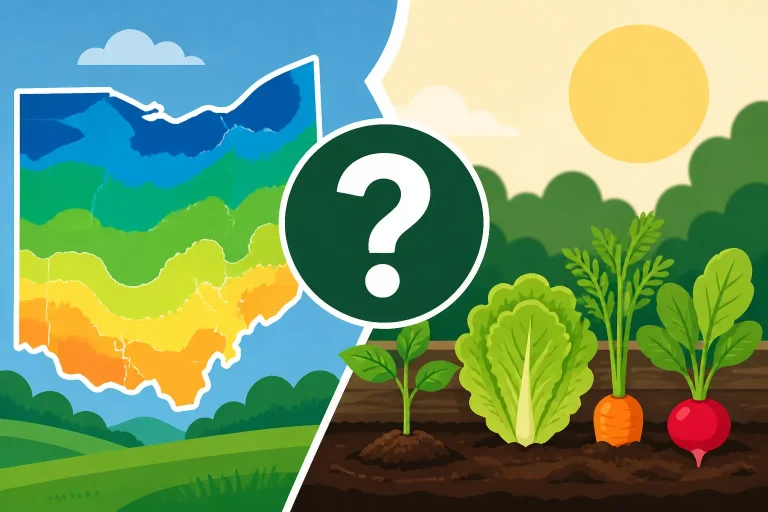
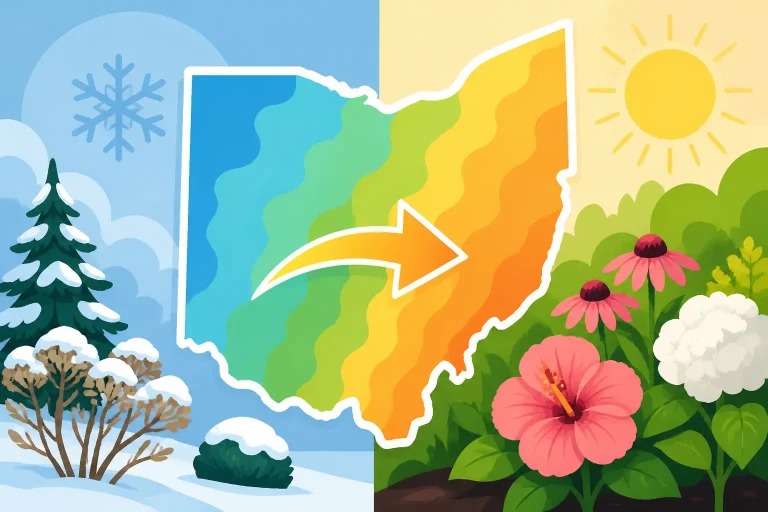
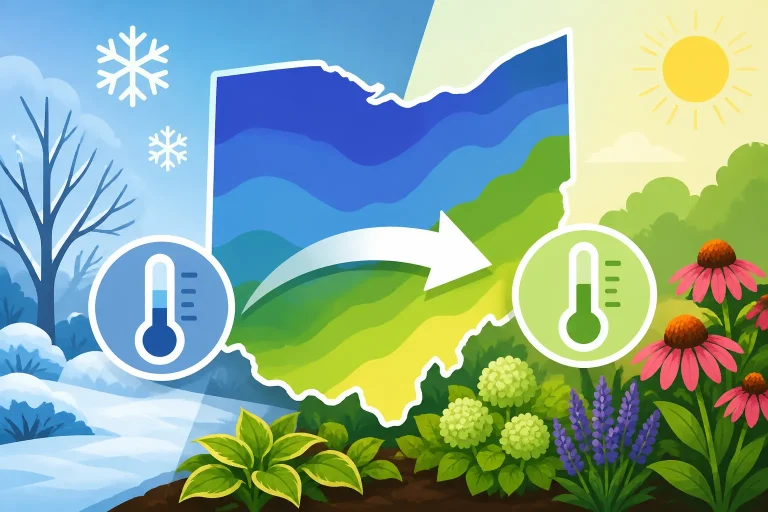
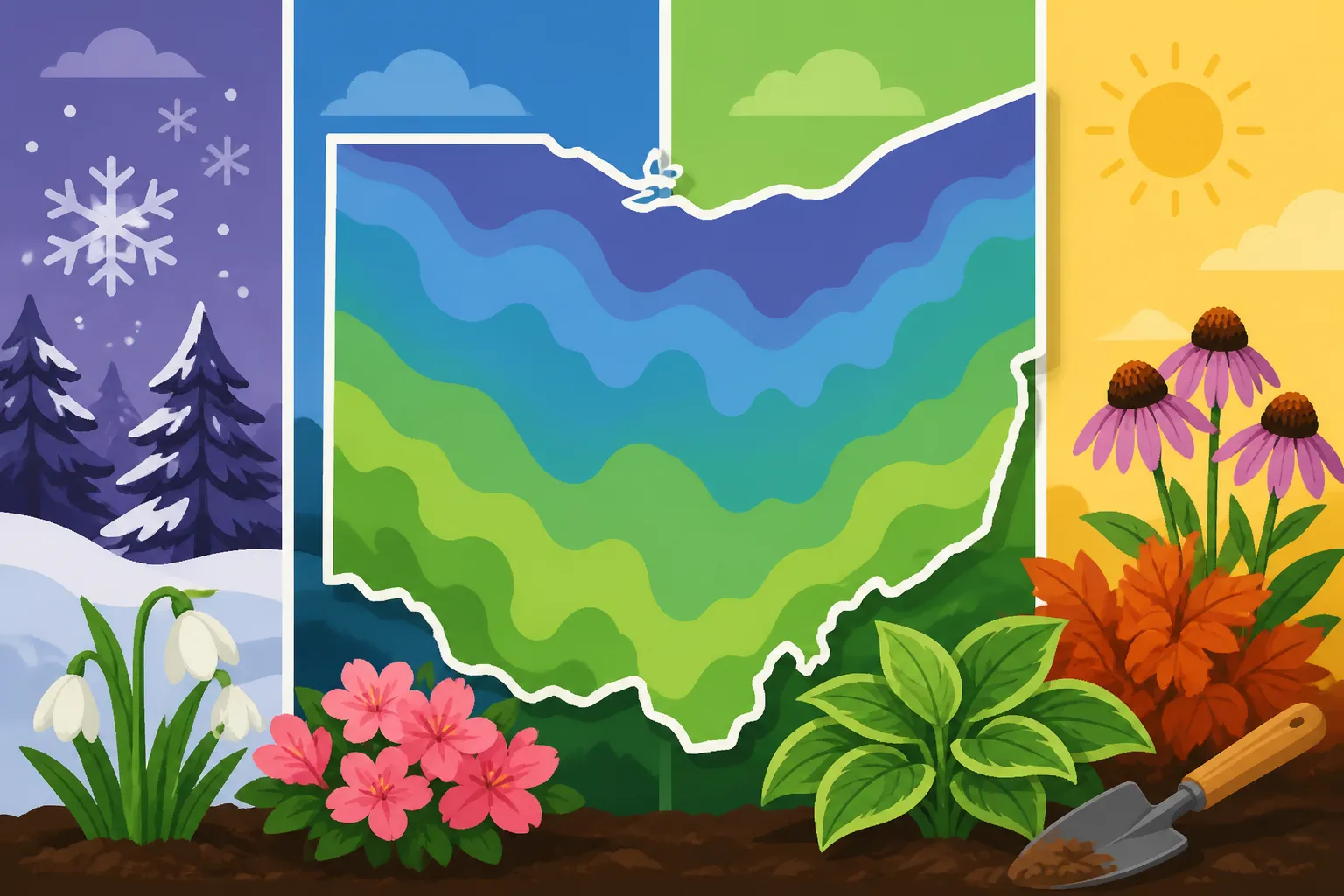
Ohio is not represented by one uniform winter pattern. The state’s plant zones vary across the map, and the zone shading reflects regional differences in winter cold. The Ohio State University State Climate Office of Ohio notes that parts of Ohio are transitioning from Zone Five to Zones Six or Seven. This gives a broad indication of shifting zone classifications, but it does not assign a zone to every community or property.
A state map can make the pattern look simple: one color ends, another begins, and a gardener checks which color covers a town. In practice, the boundary is a regional guide. The map is useful for comparing areas, but a color boundary should not be treated as a precise line across a yard. Nearby locations can have different exposure, drainage, elevation, and shelter.
That distinction matters for gardeners in any part of Ohio. A location near a lake, in a valley, on a slope, or beside a dense group of buildings may experience conditions that differ from an open site nearby. These local features do not automatically change the map’s zone designation, but they can affect how a plant performs in that particular garden.
The map’s regional divisions are still valuable. They help explain why a plant that survives comfortably in one part of Ohio may be less reliable elsewhere. They can also give gardeners a better way to compare nursery descriptions and decide which plants deserve closer research before purchase. If you are comparing areas within the state, Northeast to Southern Ohio: Reading the Regional Plant Zones Map can help frame that regional perspective.
Do not assume that all parts of a county share identical conditions, or that a city label predicts a yard’s exact winter experience. A map is built to communicate regional patterns, not to assess a specific planting bed. When selecting plants, think of the zone as a broad description of the area, then examine the site where the plant will actually live.
Ohio’s changing zone patterns can also make older gardening advice feel inconsistent. A recommendation written for a broad region may not match the current map label for every location. That does not mean all older advice is useless. It does mean gardeners should check which map edition the recommendation refers to and whether the advice is about winter survival, seasonal planting, or a different growing condition altogether. For background on what map updates mean, see Understanding Recent USDA Hardiness Zone Revisions.
Why the zone label is not a planting calendar
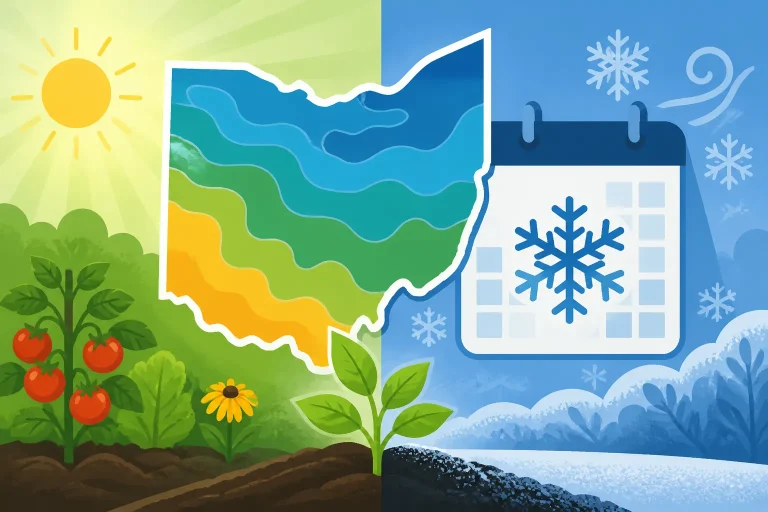
Hardiness zones describe winter cold patterns, not the safe date for planting every crop. A vegetable garden has a different timing problem: seeds and young plants respond to soil temperature, air temperature, frost risk, and the needs of each crop. A zone label does not tell you when the last spring frost will occur or when the soil will be warm enough for a tender crop.
This is one of the most common sources of confusion. A gardener sees a warmer zone on a map and assumes that warm-season vegetables can go outside earlier. But a broad winter-hardiness label cannot determine whether a particular spring will bring a late cold spell. A plant that is hardy in winter can still be damaged by a spring freeze when it is actively growing or flowering.
The same issue applies in autumn. A zone is not a countdown to the first fall freeze, and it does not guarantee how much time a late crop has to mature. A garden’s growing window depends on seasonal weather, local frost patterns, crop maturity, and whether plants are protected. For vegetable timing, consult Hardiness Zones vs Frost Dates: What Controls Ohio Planting Timing and Ohio Cool-Season Sowing Windows: Early Spring Through Fall.
Use the zone map to consider whether a perennial is likely to overwinter. Use frost information and crop-specific guidance to decide when to sow or transplant vegetables. These are related decisions, but they answer different questions. One asks whether a plant can live through winter in a region. The other asks whether a crop can safely grow outdoors during a particular part of the year.
This distinction is especially useful when reading plant tags. A tag may provide a hardiness range, but it may not give a planting window for your yard. For a perennial, the zone can help you judge winter risk. For a vegetable transplant, the season, forecast, and crop’s sensitivity to cold are more relevant. The tag is only one piece of the decision.
For example, choosing a hardy perennial for a border is not the same task as deciding when to plant tomatoes. The perennial’s ability to survive winter matters over the long term. The tomato’s tender growth must instead be matched to spring conditions and the remaining growing season. Separate those decisions and it becomes easier to use the information each resource provides.
Gardeners who want a month-by-month view of outdoor tasks can use Annual Ohio Planting Calendar: Month-by-Month Outdoor Chores. For more on local seasonal timing, Spring Frost Probabilities and Garden Planting Across Ohio explains why a regional frost estimate should be treated as a probability rather than a fixed promise.
How to use the USDA map for your location
Start by looking up the map for the area where you plan to garden. A city or ZIP code can help orient you, but the zone shown for a broad location should not be mistaken for a guarantee about a specific address. The USDA map is a regional tool, and the best way to interpret it is alongside local site conditions and plant-specific information. For help using map tools, see Using the Interactive USDA Zone Map for Your Ohio Address.
When reading a zone label, pay attention to the complete designation rather than only the broad zone number or color. The map includes subdivisions, and those can help distinguish areas with somewhat different winter patterns. A small difference on a map does not make one location risk-free and another unsuitable; it adds context to the general picture.
Next, check the plant’s hardiness information. If a nursery description gives a range, compare it with the map designation for your area. If the plant is at the colder edge of its recommended range, treat it as a higher-risk choice than a plant with a broader margin. Ask whether you are comfortable with the possibility of winter injury or replacement, and whether the site offers shelter.
Then consider where the plant will go. An open, windy bed can be more demanding than a protected space near a building or under a canopy. A low spot that holds water may create different challenges from a well-drained slope. These are not alternate zone assignments; they are site factors that influence whether a plant succeeds within the mapped region.
Finally, check for information beyond hardiness: sunlight, soil drainage, moisture needs, mature size, and maintenance. A plant with the right winter rating may still fail if it is planted in a place that stays waterlogged or receives too much shade. Matching the plant to the site is just as important as matching it to the region.
A useful decision process is:
- Identify the broad zone shown for the place you garden.
- Check the plant’s recommended hardiness range and note whether your location is near its colder limit.
- Assess the planting site for exposure, drainage, shelter, and sunlight.
- Look for Ohio-specific guidance or recommendations for similar local conditions.
- Decide whether the plant’s winter risk and care needs suit your plans.
Treat those steps as a way to organize information, not as a guarantee of survival. A zone label cannot account for every winter or every garden. A careful choice reduces uncertainty; it does not remove it.
If a plant is marginal for your location, think through the consequences before planting. An expensive or slow-growing specimen may be a poor experiment in a highly exposed site. A small trial planting may make more sense if you are willing to accept losses. Some gardeners prefer dependable plants that fit their conditions, while others are willing to experiment with plants near the edge of their range. Neither approach is automatically better; the right choice depends on the purpose of the garden and your tolerance for risk.
Why neighboring gardens can behave differently
The map’s broad divisions do not capture every detail of a property. Two gardens in the same area can expose plants to very different conditions. One may be sheltered by buildings and trees, while another is open to wind. One may drain freely, while the other stays wet after rain or snowmelt. Those differences can affect plant health, even when the gardens share the same mapped zone.
A sheltered location can reduce exposure to cold wind, but it can also create other complications. Walls may reflect heat or create uneven conditions, and dense shade can limit the light a plant needs. A low, damp site may cause root problems that have little to do with the minimum winter temperature. Microclimates are helpful clues, not automatic solutions.
Elevation and terrain can matter as well. Cold air can settle in low places, while slopes and elevated sites may experience different exposure and drainage. The details vary from property to property, so a gardener should observe how the site behaves rather than assume a particular landform always offers protection.
Snow cover can also influence winter survival by insulating plants near the ground. But gardeners cannot count on snow staying in place throughout winter. The amount, timing, and duration of snow cover vary. Plants exposed above the snow line may face conditions different from roots or low stems protected beneath it.
Wind exposure is another practical consideration. Drying winter winds can stress evergreen foliage and exposed stems. A plant may be hardy in a regional sense but still suffer damage in a particularly exposed position. Windbreaks and sheltered siting can help, though they do not convert a site into a different USDA zone.
These local differences explain why gardeners sometimes report conflicting results about the same plant. One person may have a thriving specimen, while another loses it. Both observations can be true if the gardens differ in drainage, shelter, soil, age of the plant, or winter exposure. A single success story is useful evidence, but it is not a guarantee for every garden.
Keep notes about how plants perform in different parts of your yard. Record where a plant is located, whether the site is sunny or shaded, how well it drains, and what winter damage appears. Over time, those observations can reveal which spots are more exposed and which plants are dependable. This local record helps you make better choices than relying on a zone label alone.
When a plant struggles, consider the full set of conditions before concluding that the zone was wrong. Poor drainage, drought stress before winter, disease, transplant shock, or unsuitable light can all contribute to decline. If the plant’s zone rating seemed appropriate, investigate those factors before replacing it with another plant that has the same needs.
Choosing plants and planning garden beds
A zone-aware planting plan begins with a simple distinction: winter survival is one criterion among several. Before choosing a tree, shrub, or perennial, confirm that it can tolerate the region’s winter conditions, then match its needs to the actual spot. A plant that fits both the broader region and the local site is more likely to become a lasting part of the landscape.
For a mixed border, avoid choosing every plant by the same rule. Some plants may be hardy but need full sun; others may tolerate shade but require well-drained soil. Group plants with similar light and moisture needs so that the whole bed is easier to manage. For a broader approach to selecting perennial plants, see Matching Perennials to Your Soil, Sun, and Ohio Hardiness Zone.
Pay particular attention to plants that are close to the edge of their stated hardiness range. Ask whether the plant’s value justifies the risk, whether a more sheltered site is available, and whether you are prepared to provide protection if conditions are harsh. Protection can reduce some risks, but it cannot make every plant dependable in every location.
When choosing trees or shrubs, also consider their mature size and the conditions they will face once established. A young plant may receive extra attention, but a mature specimen has to cope with the site over the long term. Select a location that suits its light, soil, drainage, and space needs rather than relying on winter hardiness alone.
For vegetables, use a separate planning method. Match sowing and transplanting to each crop’s tolerance for cold and the conditions in the garden. Consider soil warmth, frost risk, and the amount of growing time available. A plant’s winter-hardiness rating is not a substitute for a crop-specific schedule. When Can You Plant Vegetables in Ohio? Timing by Season is a useful next step for that question.
Gardeners planning a new bed can also use hardiness information to decide which plants are reasonable long-term choices. Then narrow the list based on the site: sunlight, soil, moisture, and mature size. If there are several appealing options, compare what each needs rather than choosing solely by flowers, foliage, or a zone printed on a label.
A useful comparison looks like this:
| Question | What the answer helps you decide |
|---|---|
| What zone is shown for the area? | Whether the plant is a plausible regional winter choice |
| Is the plant near the colder edge of its range? | How much winter risk to expect |
| Does the site drain well? | Whether roots are likely to face persistent wetness |
| How exposed is the planting spot? | Whether wind and open conditions may add stress |
| Does the plant get suitable light? | Whether it can grow well through the season |
| Is the question about a vegetable crop? | Whether frost and soil conditions matter more than the zone label |
If you are choosing among several plants, compare them against the same site conditions. A plant that requires less shelter may be a better fit for an exposed border. A plant that needs consistent moisture may suit a different bed from one that dries quickly. This helps turn a general map designation into a practical planting decision.
It is also reasonable to favor plants with a comfortable margin rather than testing the edge of the map. That approach can make a landscape more dependable and reduce the need to replace winter-damaged plants. Gardeners who enjoy experimentation can still set aside a suitable spot for less certain choices, but they should recognize the possibility of loss.
What zone shifts mean for Ohio gardeners
Zone boundaries can change when maps are revised, and an area may receive a different designation than it did on an earlier map. According to The Ohio State University State Climate Office of Ohio, parts of Ohio are transitioning from Zone Five to Zones Six or Seven. A change in label is useful information, but it should not be read as a guarantee that winter injury will no longer occur.
A warmer map designation can encourage gardeners to reconsider plant choices, especially for landscape plants that were previously treated as marginal. Even so, the new designation does not mean that every plant associated with a warmer zone will thrive on every property. The map describes a broad pattern, while exposure, soil, moisture, and plant condition still shape the outcome.
Likewise, a new zone label does not mean a gardener should immediately replace established plants or discard previous local observations. A plant that has performed well in a yard may remain a good choice. A plant that has repeatedly struggled may have a site problem, or it may be too vulnerable to the yard’s winter conditions. The map update is one more piece of evidence to weigh.
When a map changes, check the edition used by the plant reference or gardening advice you are reading. Older advice may use a previous map designation, but the underlying observations about drainage, sunlight, plant care, and local exposure may still be useful. Separate the zone information from the other practical guidance instead of treating an older recommendation as entirely right or entirely wrong.
Use a changed designation as a reason to review your plant list, not as a reason to assume conditions have become predictable. If you are considering a plant that was previously outside the usual recommendation for your area, check current plant-specific information and assess the risks at the planting site. A sheltered trial can be a measured experiment; a large, exposed planting may carry more risk.
For a deeper look at how regional labels have changed, see Ohio Zone Shifts: How the Updated USDA Plant Hardiness Map Changed. If the decision involves frost-sensitive plants or crops, use separate seasonal guidance rather than interpreting the zone shift as a planting date.
Common mistakes when reading Ohio plant zones
Treating a zone as a guarantee
The zone label is a guide to regional winter conditions, not a promise that a plant will survive every winter. Severe or unusual weather, exposure, poor drainage, and plant stress can all affect survival. Think in terms of likelihood and suitability, not certainty.
Using a city label as a yard diagnosis
A community-level result can orient you, but it does not account for the microclimate of a particular bed. Do not assume that a protected spot and an exposed slope behave alike just because they fall within the same mapped area. Use the location result as context and observe your site.
Confusing hardiness with spring planting safety
A plant that can survive winter may still be damaged by a spring freeze while it is actively growing. A zone label does not supply a frost date or tell you whether it is safe to set out a tender crop. Check crop-specific planting guidance and local frost information for those decisions.
Choosing plants from the zone number alone
A matching zone is a good first filter, but it says little about sunlight, soil, moisture, mature size, or maintenance. Check the plant’s full needs before buying it. The right winter rating cannot compensate for a poorly matched site.
Ignoring uncertainty at a zone boundary
Maps simplify a complex landscape. If your location sits near a transition, treat the label as a regional guide rather than a sharp dividing line. Check plant descriptions carefully, consider local observations, and decide how much risk you are willing to accept.
Assuming a changed zone erases local experience
Map revisions can alter a label without making every garden respond identically. Keep track of what performs well in your yard. Local observations help show how a plant handles that site, while the map helps put those observations in a broader regional context.
Frequently Asked Questions
Does a USDA hardiness zone tell me when to plant vegetables in Ohio?
No. A hardiness zone helps assess whether perennial plants may survive winter. Vegetable timing depends on crop needs, soil and air conditions, and frost risk. Use a seasonal planting resource for sowing and transplanting decisions.
Can two gardens in the same Ohio zone have different results?
Yes. Shelter, wind exposure, drainage, sunlight, terrain, and plant condition can differ from one yard to another. The map gives a regional reference, not a complete description of a planting site.
Should I choose a plant if its rating is near the edge of my area’s zone?
You can, but treat it as a higher-risk choice. Check the plant’s needs, consider whether the site offers shelter, and decide whether you are willing to accept possible winter damage or loss.
Does a warmer zone label mean winter damage is no longer a concern?
No. A warmer designation can inform plant selection, but it is not a guarantee about future weather or a particular yard. Continue to consider exposure, drainage, plant health, and local conditions.
Sources
- The Ohio State University State Climate Office of Ohio — Plant Hardiness Map Reflects Climate Change Impacts on Ohio | State Climate Office of Ohio (checked November 14, 2026)
Disclaimer
This article is for general informational purposes only and does not constitute professional advice. Laws, prices and regulations vary by location and change over time. Consult a qualified professional for guidance on your specific situation. Ohio Gardening Guide is not a government agency and is not affiliated with any university extension, state department of agriculture or other government agency.